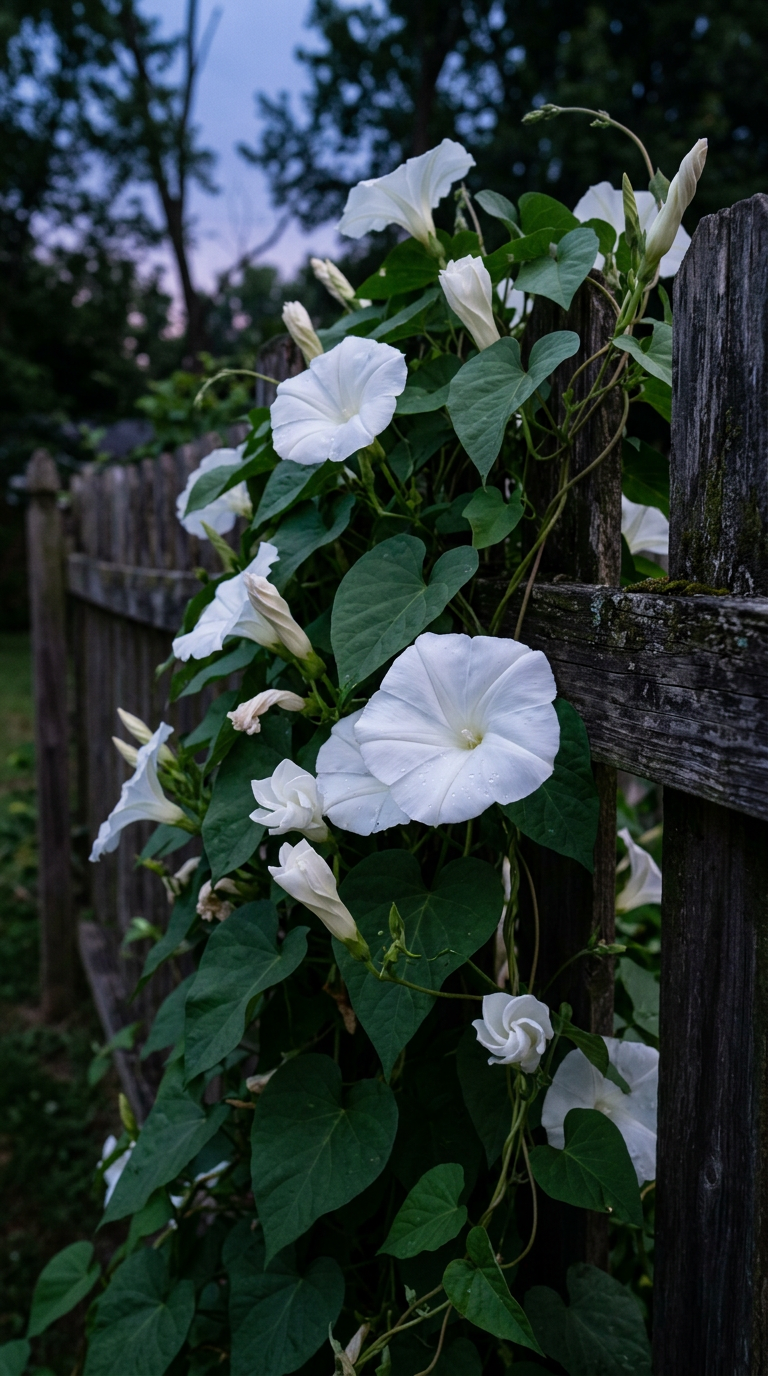
Discover why moonflowers bloom after dark, their fascinating moth pollinators, lunar symbolism, and how to grow these beautiful nighttime flowers.

As the sun slips below the horizon and the garden begins to settle into twilight, something extraordinary is about to happen. Tucked among twisting vines and heart-shaped leaves, a pale green bud begins to stir. Slowly, its tightly curled petals loosen, unfurling into a magnificent white blossom that seems to glow in the fading light.
While most flowers prepare to rest for the night, the moonflower is just waking up.
Known botanically as Ipomoea alba, this remarkable climbing vine has a secret life that unfolds beneath the evening sky. Its fragrant blossoms attract mysterious nighttime visitors, its petals perform a beautiful botanical transformation, and its moonlike appearance has inspired modern garden symbolism.
Step into the moonflower’s world, where the garden comes alive after dark.
A Flower That Waits for the Moon
Moonflowers belong to the morning glory family, but unlike their sun-loving relatives, they save their grand entrance for the evening.
Throughout the day, their flower buds remain tightly twisted, almost like tiny green umbrellas. As dusk approaches, the petals begin to loosen. On warm evenings, a moonflower can transform from a closed bud into an open blossom in just a few minutes.
The flowers can reach approximately six inches across, displaying broad, luminous white petals that stand out beautifully against deep green foliage. Their sweet fragrance becomes part of the evening garden’s atmosphere.
But there is something wonderfully fleeting about this performance.
Each flower generally enjoys a single night of glory. By the following morning, its petals begin to wilt, leaving the vine to prepare another set of blossoms for the coming evening.
For anyone fortunate enough to witness a moonflower opening, it is a reminder that some of nature’s loveliest moments are also its briefest.
The Midnight Visitors: A Secret Garden Partnership
The moonflower’s nighttime schedule isn’t simply an unusual botanical habit. It serves a fascinating purpose.
While bees and butterflies are familiar daytime visitors, moonflowers attract another kind of pollinator: night-flying moths.
Among these visitors are sphinx moths, sometimes called hawk moths. With their strong wings and ability to hover near flowers, some resemble tiny hummingbirds moving through the darkness.
Moonflowers are beautifully suited to these nighttime encounters. Their pale petals are easier to distinguish in low light, and their sweet fragrance helps attract pollinators searching for nectar.
As a moth visits a blossom, it may carry pollen between flowers, helping the plant reproduce.
It’s a quiet partnership that often goes unnoticed. While the rest of the world sleeps, an entire community of insects is still working among the leaves.
A little garden discovery: You don’t need a full moon to enjoy moonflowers. Their opening is connected to the evening light cycle, not a requirement for moonlight.
Moonflowers, Folklore, and the Green Witch’s Garden
With such an unusual relationship to the night, it’s easy to understand why moonflowers feel at home in a green witch’s garden.
In contemporary nature-centered spiritual practices, moonflowers can symbolize intuition, transformation, feminine or lunar energy, and the beauty of hidden things. Their evening blossoms make them a lovely personal reminder to slow down and notice what the daylight sometimes overlooks.
Rather than belonging to one universal ancient tradition, these associations are best understood as modern symbolic interpretations inspired by the flower’s natural behavior.
Imagine a quiet garden corner decorated with weathered pots, silver-toned foliage, and climbing moonflowers. A comfortable chair rests beneath the vines, while a small lantern casts a warm glow over the leaves.
Such a space can become a peaceful place for journaling, reflection, or simply listening to the sounds of an evening garden.
Sometimes the most meaningful garden ritual is giving yourself permission to be still.
Growing a Little Moonlight of Your Own
Despite their mysterious appearance, moonflowers are surprisingly approachable garden plants, especially for gardeners with sunny spaces and warm summers.
These vigorous climbers love sunshine during the day, even though their flowers bloom at night.
A few simple considerations will help them thrive:
- Choose a sunny location. Give moonflowers plenty of direct sunlight and well-draining soil. A large container with drainage holes can also work beautifully.
- Prepare the seeds. Their hard seed coats can slow germination. Lightly nicking the seed coat or soaking seeds overnight in warm water can help them sprout.
- Give them something to climb. A sturdy trellis, fence, or garden arch provides support for their long, twining vines.
- Keep them comfortably watered. Maintain evenly moist soil without allowing the roots to sit in soggy conditions.
- Make time for the evening show. When buds begin forming, visit the garden around dusk. You might catch a blossom unfolding before your eyes.
In cooler climates, moonflowers are commonly grown as annuals because they cannot tolerate freezing temperatures. In warmer regions, they may grow as tender perennials.
A thoughtful safety note: Moonflower seeds are toxic if eaten, and the plant presents risks to pets. Keep seeds and plants away from curious animals and children. Also check botanical names when purchasing: some highly poisonous Datura species share the common name moonflower, but they are different plants.
The Beauty of a Garden That Never Truly Sleeps
There’s a lovely lesson hidden within the moonflower’s unusual rhythm.
Gardens are often celebrated for their bright mornings, busy bees, and colorful afternoon displays. Yet the moonflower reminds us that an entirely different world begins when the daylight disappears.
Some flowers flourish in sunshine. Others wait patiently for the stars.
And perhaps that is what makes moonflowers so captivating. They invite us to become curious about the quieter side of nature, to linger outside a little longer, and to discover that beauty doesn’t always follow the same schedule.
The next time evening falls, imagine a white blossom slowly opening somewhere in the darkness, ready to welcome its midnight visitors.
Would you plant moonflowers in your garden, or have you ever watched one bloom after sunset?


Leave a Reply