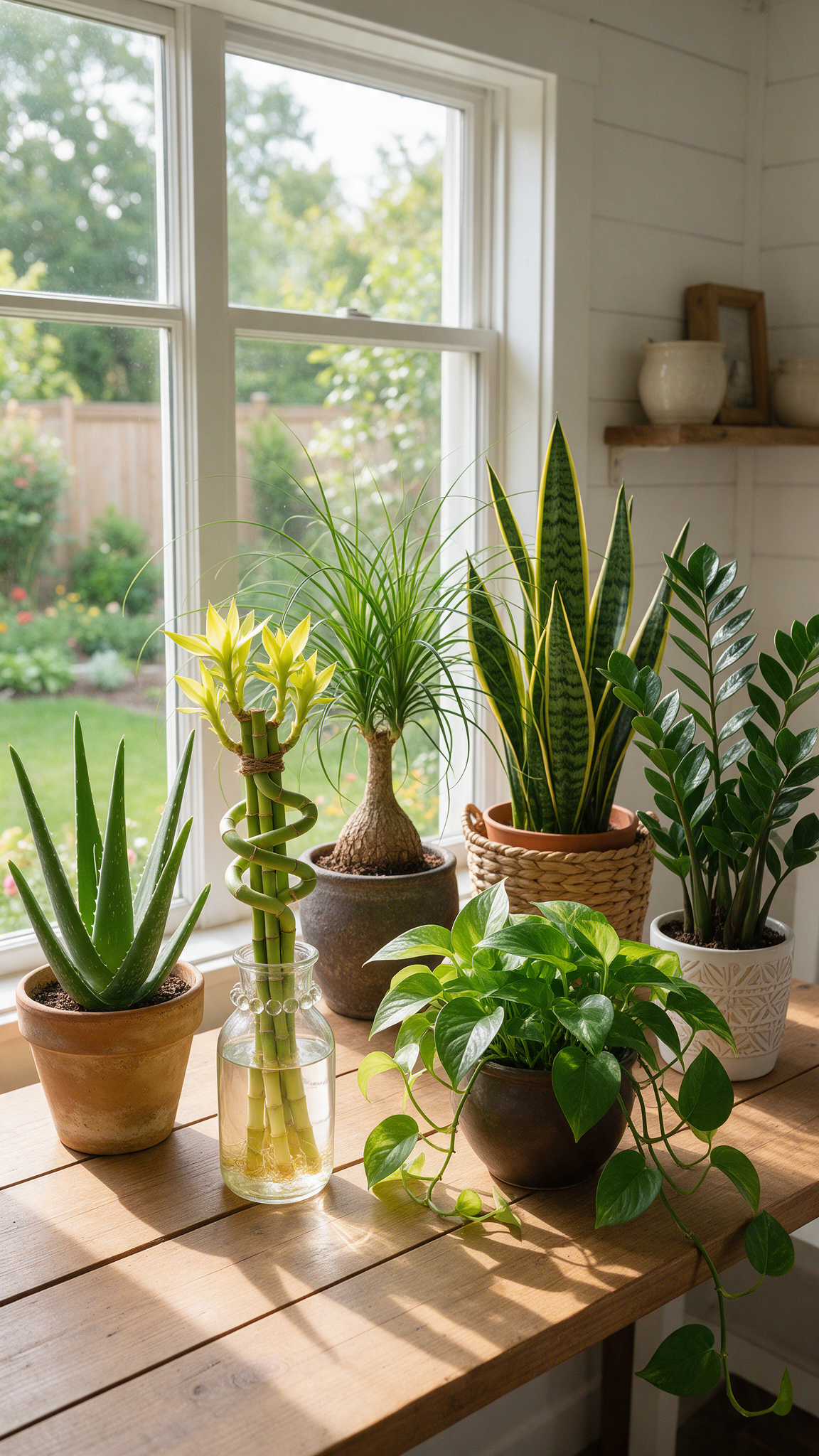

You do not need a backyard to begin building a relationship with plants.
An indoor garden can start with one pot sitting on a windowsill.
Then another appears on a bookshelf.
A trailing vine finds its way across a cabinet.
Before long, you have created your own little indoor ecosystem.
For a beginner green witch, houseplants are especially wonderful because you interact with them every day. You learn to recognize when leaves are thirsty, when new growth is appearing, which direction a plant reaches toward the light, and how dramatically different plants respond to the same room.
But your first plants should not make you miserable.
Some houseplants can be surprisingly demanding. The six plants below are generally forgiving, adaptable, and beginner-friendly.
They are: Aloe, Lucky Bamboo, Pothos, Ponytail Palm, Snake Plant, and the ZZ Plant.
Each one has a different personality and can teach you something different about plant care.
Aloe
Common Name
Aloe Vera, True Aloe, Medicinal Aloe
Botanical Name
Aloe vera
Aloe vera is an evergreen succulent. Current botanical references place its native range in the Arabian Peninsula, with Kew identifying northern Oman as its native range; it has since become widely cultivated and naturalized around the world. (Plants of the World Online)
Folklore & Green Witch Symbolism
Aloe has a long association with healing, soothing, protection, and resilience.
Part of this symbolism naturally developed from the plant’s practical history. Aloe gel has been used traditionally on the skin, so it is easy to understand why generations of people began associating the plant itself with healing.
For a modern green witch, aloe can represent:
- Healing
- Protection
- Recovery
- Resilience
- Self-care
- Boundaries
- Survival
Look closely at an aloe plant and its symbolism almost writes itself.
It stores what it needs inside thick leaves.
It can endure dry periods.
Its leaves are soft and soothing inside while being edged with tiny teeth on the outside.
There is a beautiful lesson there:
You can be healing and still have boundaries.
Who Is Aloe Good For?
Aloe is an excellent choice for someone who:
- Sometimes forgets to water
- Has a bright window
- Wants to try growing a succulent
- Likes plants with unusual shapes
- Wants something fairly low-maintenance
- Tends to love plants a little too much with the watering can
In fact, overwatering is usually much more dangerous to aloe than occasionally forgetting about it.
Where Is Aloe From?
Aloe vera is associated with the dry environments of the Arabian Peninsula and has been cultivated around the world for centuries. (Plants of the World Online)
Understanding that origin gives you a clue about how to care for it.
Think: Bright. Dry. Well-drained.
Not: Dark. Wet. Swampy.
Water Requirements
Allow the soil to dry thoroughly between waterings.
Then water deeply and allow the excess water to drain away.
Do not leave the pot sitting in water.
Aloe usually needs less water during winter when growth slows. Constantly wet soil can cause root rot.
For beginners, it is better to check the soil than to water on a strict schedule.
Light Requirements
Aloe loves plenty of light.
A bright window is ideal. It can handle strong light, although plants that have been living in lower indoor light should be introduced to stronger direct sun gradually to avoid scorching.
Space Requirements
Aloe grows outward in a rosette rather than becoming a long vine.
Give its leaves enough room to spread without constantly brushing against furniture or other plants.
Mature plants can also produce little offsets, often called pups, around the base.
Those can eventually become new plants.
Pot Requirements
Drainage is essential.
Choose a pot with a drainage hole—or several.
Terracotta is especially useful because it allows the soil to dry faster.
Avoid putting aloe into a giant pot. A container only somewhat larger than the root system makes moisture easier to control.
Soil Requirements
Use a cactus or succulent potting mix.
The goal is fast drainage.
Dense garden soil or potting soil that remains wet for long periods can quickly cause problems.
🌿 Green Witch Lesson From Aloe
Protect your energy, store what nourishes you, and remember that softness and boundaries can exist together.
Lucky Bamboo
Common Name
Lucky Bamboo, Friendship Bamboo, Chinese Water Bamboo
Botanical Name
Dracaena sanderiana
Here is the first surprise:
Lucky bamboo is not actually bamboo.
It belongs to the genus Dracaena. Its native range extends through western Central Tropical Africa into northeastern Angola.
Folklore & Green Witch Symbolism
Lucky bamboo is strongly associated in modern home symbolism and feng shui-inspired practice with:
- Luck
- Prosperity
- Happiness
- Growth
- Harmony
- Friendship
- Positive energy
- New beginnings
It has become especially popular as a housewarming, friendship, and good-luck plant.
For a green witch, lucky bamboo can make a beautiful addition to a prosperity space, intention shelf, work desk, or place associated with new beginnings.
Its symbolism is particularly fitting because the plant continues producing fresh green growth from fairly simple-looking stems.
Who Is Lucky Bamboo Good For?
Lucky bamboo is wonderful for:
- First-time plant owners
- Apartment dwellers
- Desk gardeners
- People with limited space
- People without extremely bright windows
- Anyone who likes plants that can grow in water
- Someone building a prosperity or abundance corner
It is also a fun choice if traditional potting soil feels intimidating.
Where Is Lucky Bamboo From?
Despite its strong association with Asian-inspired décor, Dracaena sanderiana is native to tropical Africa, including areas from western Central Africa into northeastern Angola.
That is one of the reasons learning botanical names can be so interesting.
Common names do not always tell a plant’s real story.
Water Requirements
Lucky bamboo is unusual because it can be grown either in soil or water.
When grown in soil, keep the potting mix moist but not constantly waterlogged.
When grown directly in water, the roots can be supported with pebbles. NC State recommends chlorine-free water and regular water changes.
If the leaves begin yellowing, pay attention to water quality, light, and overwatering.
Light Requirements
Lucky bamboo prefers bright, indirect light.
It tolerates lower-light conditions better than many houseplants, but harsh direct sun can damage the foliage.
Space Requirements
Lucky bamboo is excellent for small spaces.
It grows upright rather than sprawling across furniture.
A few stems can sit comfortably on:
A desk.
A shelf.
A bathroom counter.
A kitchen windowsill.
A small altar.
Pot Requirements
If growing it in water, choose a sturdy container that will not tip over as the plant becomes taller.
Pebbles can help hold the stems upright.
If growing in soil, use a regular container with drainage.
Soil Requirements
Lucky bamboo can grow in a moist, ordinary houseplant potting mix.
Unlike aloe or ponytail palm, it does not want to become bone dry for extended periods.
🌿 Green Witch Lesson From Lucky Bamboo
Growth does not always require perfect circumstances. Find the light available to you and keep reaching toward it.
Pothos
Common Name
Pothos, Golden Pothos, Devil’s Ivy, Devil’s Vine
Botanical Name
Epipremnum aureum
Pothos is one of the classic beginner houseplants.
It is a tropical climbing plant native to Mo’orea in the Society Islands and is now widely grown around the world.
Folklore & Green Witch Symbolism
Because pothos grows quickly, trails, climbs, roots easily from cuttings, and can survive conditions that defeat many other houseplants, modern plant symbolism often connects it with:
- Perseverance
- Abundance
- Growth
- Adaptability
- Expansion
- Prosperity
- Resilience
For a green witch, pothos is an especially lovely plant for representing continuous growth.
One plant can eventually create dozens of cuttings.
Those cuttings can become new plants.
Those plants can be shared.
Something that began as one small vine can spread throughout your home and into the homes of your friends.
That feels like abundance in living form.
Who Is Pothos Good For?
Almost everybody.
Pothos is particularly good for:
- Complete beginners
- Apartment dwellers
- Forgetful gardeners
- People with lower-light homes
- People who want trailing plants
- People interested in propagation
- Anyone wanting quick, visible growth
This is one of the best plants for building confidence.
Where Is Pothos From?
Golden pothos is native to the Society Islands, specifically Mo’orea. It naturally grows as a tropical climber.
Water Requirements
Let the potting mix begin drying between waterings.
Do not keep pothos constantly soggy.
It is generally much more forgiving of becoming slightly dry than sitting in waterlogged soil.
NC State recommends well-drained potting medium and allowing it to dry between waterings.
Light Requirements
Pothos is famous for tolerating lower light.
However, tolerating low light and loving low light are not the same thing.
For fuller growth and stronger variegation, bright indirect light is usually better.
It can survive extended periods in low light, while bright indirect light encourages stronger growth.
Space Requirements
This depends on what you want your pothos to become.
You can let it:
Trail from a shelf.
Hang from a basket.
Climb a moss pole.
Grow around a trellis.
Trail across a cabinet.
Climb a wall support.
Pothos can eventually produce very long vines, so occasional pruning helps control its size.
Pot Requirements
Choose a pot with drainage holes.
A standard nursery pot inside a decorative cover pot works wonderfully.
Hanging baskets are also perfect for pothos.
If you want larger, more mature-looking growth, give it something to climb.
Soil Requirements
A basic, well-draining indoor potting mix usually works well.
The soil should retain some moisture without remaining waterlogged. (Plant Toolbox)
🌿 Green Witch Lesson From Pothos
Growth does not always have to move in a straight line. Trail, climb, change direction, root again, and keep going.
Ponytail Palm
Common Name
Ponytail Palm, Elephant-Foot Tree, Bottle Palm
Botanical Name
Beaucarnea recurvata
And here comes another misleading houseplant name:
The ponytail palm is not actually a true palm.
It belongs to the asparagus family and is native to parts of Mexico, where it naturally grows in dry environments.
Its swollen base, called a caudex, stores water.
Folklore & Green Witch Symbolism
Ponytail palm does not have the same extensive magical folklore commonly associated with plants such as rosemary or lavender.
But its physical nature makes it wonderful for modern green-witch symbolism.
It can represent:
- Resilience
- Water conservation
- Patience
- Independence
- Preparedness
- Stability
- Long-term growth
Its swollen trunk stores water for difficult times.
That makes it a beautiful living reminder of conserving resources and preparing without fear.
Who Is Ponytail Palm Good For?
This plant is fantastic for:
- Forgetful waterers
- Sunny homes
- Travelers
- People who dislike frequent plant maintenance
- Succulent lovers
- People who want an unusual statement plant
It is especially good for people whose biggest plant-care problem is overwatering—provided they can learn to leave it alone.
Where Is Ponytail Palm From?
Ponytail palm is native to Mexico, including Oaxaca, Puebla, San Luis Potosí, Tamaulipas, and Veracruz. It naturally occurs in relatively dry environments. (Plants of the World Online)
Water Requirements
Think of the swollen base as a little reservoir.
Water thoroughly.
Then wait.
Allow the soil to dry between waterings.
Water even less during winter.
Its ability to store water is one reason ponytail palm is so forgiving of occasional neglect.
Light Requirements
Give this plant a bright, sunny location.
A sunny window is ideal.
NC State recommends full sun and notes that indoor plants do well near sunny windows.
Space Requirements
Be careful with this one.
It starts cute.
It grows slowly.
But eventually it can become a substantial houseplant.
Container-grown specimens may eventually reach several feet tall, with long leaves arching outward.
Give it room where its leaves can cascade.
Pot Requirements
Choose a sturdy pot with excellent drainage.
A heavy container can be useful as the plant grows because the expanding top can eventually make a lightweight pot unstable.
Do not bury the swollen base too deeply.
Soil Requirements
Use a cactus or succulent mix or another very fast-draining soil.
Ponytail palms naturally tolerate rocky, relatively poor soil much better than constantly wet soil.
🌿 Green Witch Lesson From Ponytail Palm
Save your resources, grow slowly, and remember that slow growth is still growth.
Snake Plant
Common Name
Snake Plant, Mother-in-Law’s Tongue, Good Luck Plant
Botanical Name
Dracaena trifasciata
You may still see this plant sold under its older botanical name:
Sansevieria trifasciata
Modern botanical classification places it in the genus Dracaena. It is native to parts of tropical Africa.
Folklore & Green Witch Symbolism
Snake plants are often associated in modern plant symbolism with:
- Protection
- Boundaries
- Strength
- Good fortune
- Resilience
- Defensive energy
- Independence
The symbolism is easy to see.
Their stiff, upright leaves resemble swords rising from the soil.
For a green witch, a snake plant near an entrance can symbolically represent protecting the energy of the home.
It can also be a wonderful reminder of healthy boundaries.
Who Is Snake Plant Good For?
Snake plant is one of the best choices for:
- Absolute beginners
- Forgetful waterers
- Busy people
- Apartments
- Offices
- Bedrooms
- Lower-light homes
- Anyone who wants a structured, upright plant
This is a plant that generally prefers being ignored rather than fussed over.
Where Is Snake Plant From?
Dracaena trifasciata is native to parts of tropical Africa, including areas from southern Nigeria through western Central Africa, with its broader species range also including Tanzania.
Water Requirements
This is where beginners sometimes get into trouble.
Snake plants do not want constantly wet soil.
Allow the soil to dry between waterings.
During winter, watering may become quite infrequent.
NC State recommends especially careful watering because saturated conditions can cause root rot.
When uncertain:
Wait a little longer.
Light Requirements
Snake plants are famous for tolerating low light.
They can survive there, but brighter indirect light usually encourages better growth.
They can also tolerate some direct sunlight once properly acclimated.
Space Requirements
Snake plants grow primarily upward, which makes them excellent for tight spaces.
Try one:
Beside a dresser.
Near a doorway.
In an empty corner.
Beside a desk.
On the floor near a window.
Different varieties also come in different sizes, including compact forms.
Pot Requirements
Use a pot with drainage.
Snake plants grow from rhizomes and eventually create new shoots around the original plant.
Do not rush to repot simply because the plant seems snug. They often do perfectly well in relatively close quarters.
Soil Requirements
Use a loose, fast-draining potting mix.
A succulent or cactus mix works well.
The goal is simple:
Do not let the roots sit wet.
🌿 Green Witch Lesson From Snake Plant
Stand tall. Protect your space. You do not have to apologize for having boundaries.
ZZ Plant
Common Name
ZZ Plant, Zanzibar Gem, Eternity Plant
Botanical Name
Zamioculcas zamiifolia
The ZZ plant is native to eastern and southern tropical Africa, with a natural range stretching from Kenya toward KwaZulu-Natal and including countries such as Tanzania, Malawi, Mozambique, and Zimbabwe.
Its thick underground rhizomes store water, helping explain its impressive tolerance of neglect.
Folklore & Green Witch Symbolism
The ZZ plant has become associated in modern houseplant symbolism with:
- Prosperity
- Endurance
- Stability
- Abundance
- Persistence
- Long life
- Steady growth
Its common name Eternity Plant fits that symbolism beautifully.
For a green witch, the ZZ plant can represent the kind of prosperity that builds quietly rather than arriving all at once.
Its growth can be slow.
Then suddenly a fresh pale-green shoot emerges from the soil.
That feels like a wonderful reminder:
Not all progress is visible while it is happening.
Who Is a ZZ Plant Good For?
ZZ plants are fantastic for:
- Complete beginners
- Forgetful plant owners
- Busy people
- Office spaces
- Apartments
- Lower-light rooms
- Frequent travelers
- People who want something elegant but low-maintenance
NC State describes the ZZ plant as one of the easiest low-maintenance houseplants to grow.
Where Is the ZZ Plant From?
The ZZ plant comes from tropical Africa and naturally experiences seasonally dry conditions.
That background helps explain why its underground rhizomes have evolved to store water.
Water Requirements
ZZ plants tolerate drought extremely well.
Allow the soil to dry thoroughly before watering again.
Its fleshy rhizomes and stems store moisture, so frequent watering is unnecessary and can actually damage the plant.
NC State recommends allowing the soil to dry between waterings and watering much less during winter.
Light Requirements
ZZ plants are famous for surviving low-light environments, including offices.
But once again:
Surviving is different from thriving.
Bright indirect light is ideal.
Avoid suddenly exposing the plant to harsh direct sunlight, which can scorch the leaves.
Space Requirements
ZZ plants grow upright and outward in a neat clump.
A mature plant may eventually reach around two to four feet tall and wide, although growth is generally slow.
This makes it great for floor pots, corners, offices, and areas where a trailing vine would be inconvenient.
Pot Requirements
Use a pot with good drainage.
Because its rhizomes store water, a slightly snug container is usually preferable to an oversized pot full of wet soil.
Repot when the plant becomes genuinely crowded rather than automatically moving it into a huge container.
Soil Requirements
Choose a well-draining indoor potting mix.
Adding extra drainage material such as perlite or using a succulent-style mix can help prevent the soil from remaining wet too long.
The ZZ plant strongly dislikes what gardeners sometimes call wet feet.
🌿 Green Witch Lesson From the ZZ Plant
Growth can be happening beneath the surface long before anyone else can see it.
Which Beginner Houseplant Should You Choose?
If you are standing in a garden center staring at all six plants, think about your habits first.
If you forget to water:
Choose a ZZ Plant, Snake Plant, Aloe, or Ponytail Palm.
If you have lower light:
Try a ZZ Plant, Snake Plant, Pothos, or Lucky Bamboo.
If you have a bright sunny window:
Try Aloe or Ponytail Palm.
If you want something that trails:
Choose Pothos.
If you have very little floor or shelf space:
Try Lucky Bamboo or a compact Snake Plant.
If you want something you can propagate easily:
Start with Pothos.
If you want something dramatic but extremely forgiving:
Choose a ZZ Plant.
If you tend to overwater:
A Snake Plant, ZZ Plant, Aloe, or Ponytail Palm can teach you one of the hardest beginner gardening lessons:
Sometimes caring for a plant means leaving it alone.
Start With One or Two Plants
There is one final mistake I think new indoor gardeners should avoid.
Do not immediately buy twenty plants.
It is tempting.
You see pictures of rooms filled with greenery and want your indoor jungle immediately.
But part of becoming a gardener is learning your environment.
Start with one or two plants.
Learn which windows provide the best light.
Notice how quickly your soil dries.
Pay attention to temperature.
Watch your plant.
Learn what healthy new growth looks like.
Learn what thirsty leaves look like.
Learn what happens when you water.
Then add another plant.
And another.
Slowly, your indoor garden begins developing its own personality.
Your Home Has Its Own Growing Zones
Just as an outdoor garden contains microclimates, so does your home.
One sunny windowsill might become your desert garden, filled with aloe and ponytail palms.
A bookshelf receiving bright indirect light might become your vine garden, covered with pothos.
A darker corner could hold your snake plant and ZZ plant.
Lucky bamboo might sit on your desk as a reminder of growth and prosperity.
Begin looking at your house differently.
Ask:
Where is the morning light?
Which window receives afternoon sun?
Where is it warm?
Where is it humid?
Where could something trail?
Where could something tall grow?
Suddenly you are not simply decorating with plants.
You are creating habitats.
Let Your Indoor Garden Become Part of Your Green Witch Practice
Your houseplants do not need to be exotic or traditionally “magical” to become part of your green practice.
Water them intentionally.
Learn their botanical names.
Learn where they originally came from.
Watch new leaves unfold.
Propagate them.
Share cuttings.
Turn the pots toward the light.
Dust their leaves.
Repot them when they outgrow their containers.
Notice when growth slows during winter and begins again during spring.
Create your own correspondences based on what the plants actually teach you.
Aloe may teach you boundaries.
Lucky bamboo may teach you flexibility.
Pothos may teach you expansion.
Ponytail palm may teach you patience.
Snake plant may teach you strength.
ZZ plant may teach you that growth can happen quietly beneath the surface.
That is one of the beautiful things about building an indoor garden.
You are not simply filling your home with greenery.
You are learning how different living things grow.
And while you are caring for them, you may discover that they are teaching you something about how you grow, too.


Leave a Reply